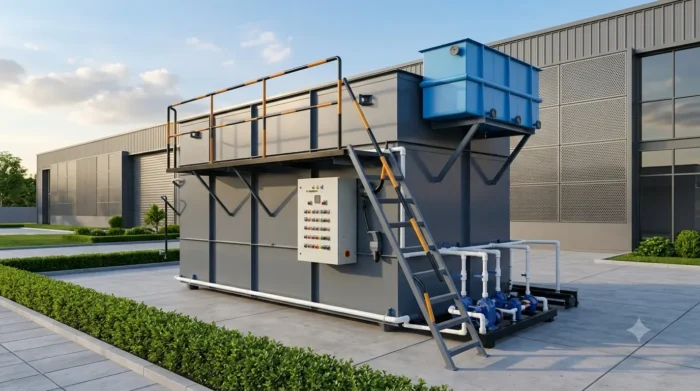
Packaged Containerized MBR Systems represent the pinnacle of modern decentralized wastewater engineering, and Hollowbrane Membrane Technologies stands at the forefront of this industrial revolution. Founded in 2021 as a research-driven, indigenous Indian innovation enterprise, Hollowbrane Membrane Technologies is proud to be India’s first indigenous manufacturer of Reinforced Polyvinylidene Fluoride (R-PVDF) Membrane Bioreactor (MBR) membranes. Built upon deep material science expertise, cutting-edge polymer engineering, and rigorous process optimization, the company translates laboratory breakthroughs into scalable, heavy-duty separation solutions.
Operating with a monthly production capacity of 20,000 m² of R-PVDF membranes and 10,000 m² of polymeric Ultrafiltration (UF) membranes, Hollowbrane Membrane Technologies delivers world-class separation solutions to municipal authorities, commercial infrastructure developers, and demanding industrial facilities. Guided by a mission to develop research-backed, sustainable water solutions and a vision to drive the future of physical separation technology, Hollowbrane bridges the gap between high CAPEX international imports and local environmental compliance demands.
The Core Advantage: Reinforced PVDF (R-PVDF) Technology
Traditional unreinforced hollow fiber membranes frequently suffer from structural failure, fibre snapping, and rapid fouling under high Mixed Liquor Suspended Solids (MLSS) conditions. Hollowbrane addresses this critical vulnerability through its proprietary Reinforced PVDF (R-PVDF) architecture.
By braiding an inner structural core coated with a high-porosity PVDF polymeric skin, Hollowbrane R-PVDF membranes deliver:
- Zero Fibre Breakage: High tensile strength prevents snapping caused by heavy aeration cycles and coarse suspended solids.
- Extreme Chemical Tolerance: Resistance to aggressive pH regimes (pH 2–10) enables intense Chemically Enhanced Backwash (CEB) and Clean-in-Place (CIP) regimes without structural degradation.
- Anti-Fouling Surface Chemistry: Optimized pore size distributions (0.01 to 0.03 micron) ensure stable flux rates (LMH) and high mechanical recovery over long operational lifespans exceeding 5 years.
Packaged Containerized MBR Systems
Packaged Containerized MBR Systems engineered by Hollowbrane Membrane Technologies are prefabricated, skid-mounted, and containerized plug-and-play wastewater treatment plants designed for rapid field deployment and minimal civil engineering footprint. Combining biological degradation with absolute physical separation using R-PVDF hollow fiber modules, these weatherproof systems deliver crystal-clear permeate in space-constrained or geographically challenging environments.
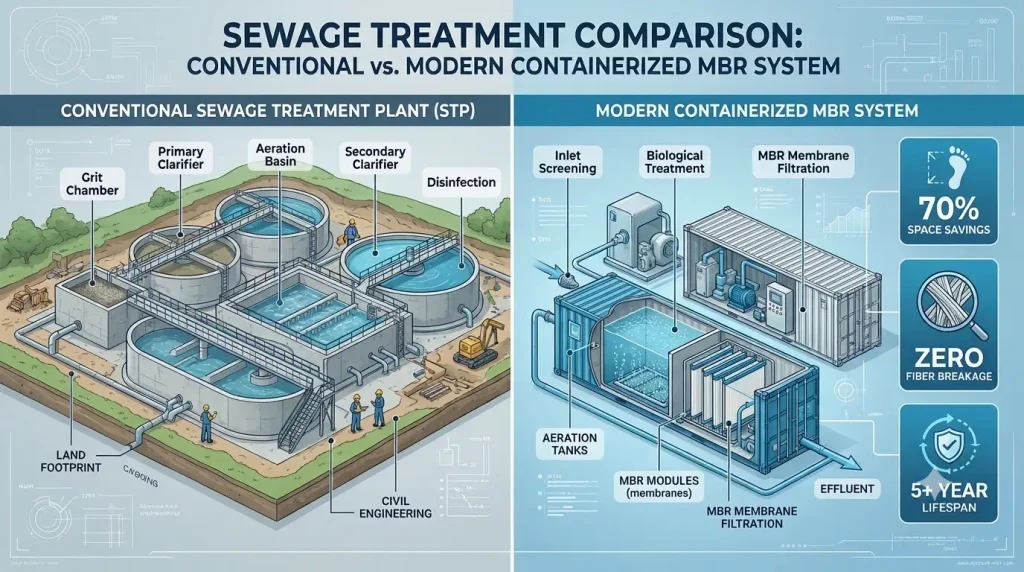
Key Structural Features & Benefits – Packaged Containerized MBR Systems
- Rapid Deployment & Plug-and-Play Setup: Completely wired, piped, and tested prior to dispatch, reducing on-site civil works and installation timelines by up to 70%.
- Unattended Automated Operations: Fully integrated PLC/HMI controls automate filtration cycles, backwashing, chemical cleaning, and alarm logging for remote site management.
- Modular Scalability: Easily scalable by adding containerized blocks in parallel as hydraulic and organic loading increases.
- Superior Effluent Quality: Consistently meets stringently mandated discharge standards, rendering treated water immediately available for non-potable reuse (toilet flushing, cooling tower make-up, and landscape irrigation).
Technical Specifications & 5-Stage Process Architecture – Packaged Containerized MBR Systems
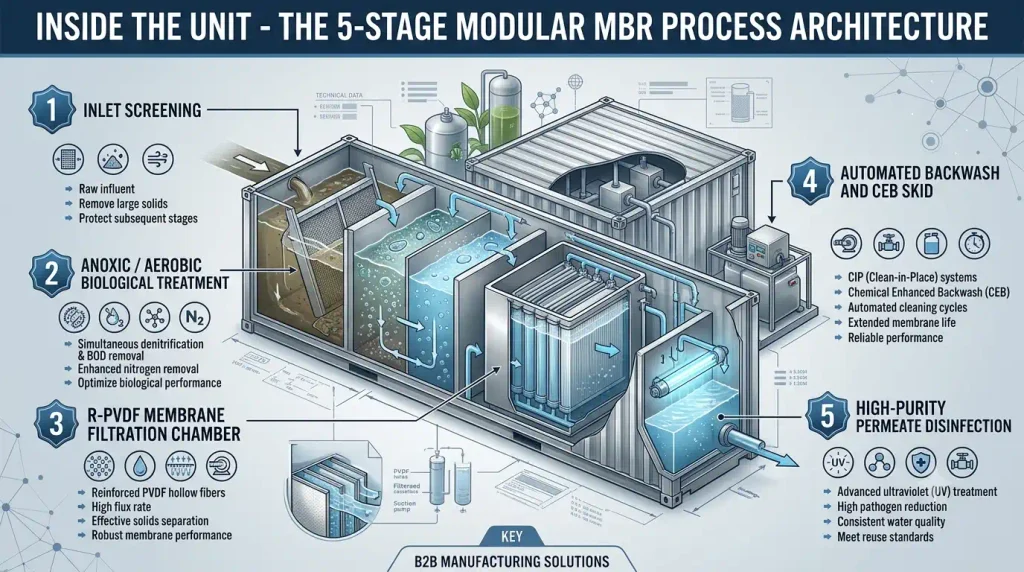
Hollowbrane’s Packaged Containerized MBR Systems consolidate advanced biological oxidation and physical membrane barrier technology into a single, fully automated, factory-tested unit. The complete treatment process operates across five distinct modular stages designed for maximum hydraulic efficiency, low energy consumption, and long membrane life.
System Operating Parameters
| Parameter | Specification / Standard |
| Membrane Material | Reinforced Polyvinylidene Fluoride (R-PVDF) |
| Nominal Pore Size | 0.04 – 0.1 microns ($\mu\text{m}$) |
| Tensile Strength | $> 200\text{ N/fiber}$ (Zero Fiber Breakage core) |
| Operating pH Range | 2 – 10 (Continuous), 1 – 11 (CIP Cleaning) |
| Permeate Quality | BOD $< 10\text{ mg/L}$, TSS $< 5\text{ mg/L}$, Turbidity $< 0.2\text{ NTU}$ |
| Automation Level | Fully automated via PLC / HMI interface with remote monitoring |
The 5-Stage Packaged Containerized MBR Systems Treatment Sequence
- Stage 1: Inlet Screening & Equalization:Raw wastewater passes through an integrated 100-micron automatic fine screen to capture grit, hair, and coarse debris, protecting downstream membranes and biological pumps from clogging.
- Stage 2: Anoxic & Aerobic Biological Treatment:Anoxic zones promote denitrification, while fine-bubble aeration diffusers supply oxygen to aerobic bacteria to rapidly degrade dissolved organics (BOD/COD) and oxidize ammonia to nitrate.
- Stage 3: Submerged R-PVDF Membrane Filtration:The mixed liquor suspended solids (MLSS) enter the membrane chamber. Vacuum pumps pull clarified water through the high-tensile R-PVDF hollow fiber pores, leaving bacteria, suspended solids, and micro-pollutants behind.
- Stage 4: Automated Backwash & CEB Skid:To prevent surface fouling and maintain high flux rates, the system executes periodic hydraulic backwashing and PLC-controlled Chemically Enhanced Backwash (CEB) or Clean-in-Place (CIP) cycles using diluted sodium hypochlorite or citric acid.
- Stage 5: High-Purity Permeate Disinfection:Permeate is passed through an inline UV disinfection assembly to ensure complete pathogen control, producing high-purity water ready for cooling towers, flush tanks, or landscape irrigation.
Sewage Treatment Plants (STP) using Packaged Containerized MBR Systems Integration
Hollowbrane manufactures custom Sewage Treatment Plants (STPs) designed to process domestic and municipal sewage. Beyond conventional biological configurations such as Activated Sludge Process (ASP), Moving Bed Biofilm Reactor (MBBR), and Sequential Batch Reactor (SBR), Hollowbrane specializes in MBR STPs engineered to eliminate secondary clarifiers and sand/carbon polishing steps entirely.
Hollowbrane MBR systems are engineered to produce high-purity effluent that aligns with global water reuse guidelines set by the US EPA and local pollution control boards.
STP Operational Performance & Capacity Matrix – Packaged Containerized MBR Systems
Designed to handle flows ranging from 10 KLD to over 1 MLD, Hollowbrane MBR STPs guarantee high pollutant removal efficiency:
| Plant Capacity (20 Hr Operating Cycle) | Technology | Average Design Flow | Treated Water BOD | Treated Water TSS | Automation Level |
| 10 KLD | MBR | 0.42 m³/hr | < 10 mg/L | < 5 mg/L | Manual / PLC |
| 20 KLD | MBR | 1.00 m³/hr | < 10 mg/L | < 5 mg/L | Manual / PLC |
| 50 KLD | MBR | 2.50 m³/hr | < 10 mg/L | < 5 mg/L | PLC Based |
| 100 KLD | MBR | 5.00 m³/hr | < 10 mg/L | < 5 mg/L | PLC Based |
Ultrafiltration (UF) Membranes & Systems – Packaged Containerized MBR Systems
Hollowbrane Ultrafiltration membranes provide an absolute physical barrier against suspended solids, colloidal matter, turbidity, and microbiological pathogens (99.99% / 4-Log to 6-Log removal of bacteria and viruses). Engineered for both standalone tertiary polishing and critical pre-treatment for Reverse Osmosis (RO) membranes, these hollow-fiber modules operate at low Trans-Membrane Pressure (TMP) regimes (0.2 bar – 1.5 bar), ensuring exceptional energy efficiency.
Designed according to rigorous physical separation standards recognized by the American Water Works Association (AWWA), R-PVDF membranes deliver consistent flux and low silt density index (SDI).
PVDF vs. PES Membrane Series Technical Comparison
| Feature / Operational Parameter | PVDF Series (Premium Line) | PES Series (Standard Line) |
| Base Polymer Chemistry | Polyvinylidene Fluoride | Polyethersulfone |
| Structural Characteristics | High Mechanical Strength (Reinforced) | High Hydrophilicity |
| Chemical Tolerance | Extreme (High Chlorine / Oxidant Resistant) | Standard (Sensitive to Strong Oxidants) |
| Flow Pattern Direction | Outside-In (Anti-Clogging Design) | Inside-In (High Flux Rates) |
| Operating pH Range | pH 2.0 – 10.0 | pH 3.0 – 9.0 |
| Primary Industrial Target | ETP Tertiary, High Turbidity Effluent | RO Pretreatment, Municipal Drinking Water |
| Expected Service Lifespan | 5+ Years | 3+ Years |
| Feed Water Turbidity Limits | < 50 NTU Standard (Up to 100 NTU Peak) | < 30 NTU Standard |
| Product Water Turbidity | ≤ 0.1 NTU Guaranteed | ≤ 0.1 NTU Guaranteed |
| Silt Density Index (SDI) | < 3.0 (100% Guaranteed) | < 3.0 (Guaranteed) |
System Features & Automation
- Integrated Auto-Backwash Pre-Filtration: Standard 100-micron auto-backwash screening prevents debris fouling on membrane fiber entries.
- PLC/HMI Cycle Control: Fully automated controls regulate forward flush, hydraulic backwash, and Chemically Enhanced Backwash (CEB) protocols.
- Smart Monitoring Arrays: Real-time digital sensors measure inlet pressure, outlet pressure, TMP differential, flow rate, and turbidity.
Effluent Treatment Plants (ETP) with Packaged Containerized MBR Systems & ZLD Integration
Industrial effluents are chemically complex, variable, and toxic compared to domestic sewage. Hollowbrane ETP systems combine primary mechanical screening, physio-chemical precipitation, and biological oxidation with MBR, UF, and RO tertiary polishing to achieve local environmental compliance or complete Zero Liquid Discharge (ZLD).
To support circular economy goals and Zero Liquid Discharge (ZLD), our advanced tertiary treatment processes mirror global best practices highlighted by the International Water Association (IWA).
Multi-Stage ETP Architecture
- Primary & Physio-Chemical Treatment: Screen chambers, oil & grease traps, flash mixers, flocculators, and primary clarifiers for chemical precipitation.
- Advanced Biological Treatment: Specialized high-shear MBR and MBBR systems to break down high Chemical Oxygen Demand (COD) and Biochemical Oxygen Demand (BOD) loads.
- Tertiary & Desalination Polishing: Advanced Oxidation Processes (AOP), Ultrafiltration (UF), and Reverse Osmosis (RO) for industrial process reuse.
Industrial ETP Scale Specifications
| Industrial Scale | Hydraulic Capacity | Typical Target Sector | Primary Process | Sludge Dewatering |
| Small Scale | 5 – 20 KLD | Hospitals, Laundries, Commercial | Manual Screening & Oil Traps | Sludge Drying Beds |
| Medium Scale | 25 – 75 KLD | Food Processing, Textile Units | DAF / Coagulation + MBR | Filter Press Systems |
| Large Scale | 100+ KLD | Pharma, Chemicals, Refineries | Automated DAF + MBR + Anaerobic | Multi-Disk Screw Press |
Dissolved Air Flotation (DAF) Machines
Hollowbrane Dissolved Air Flotation (DAF) units eliminate micro-suspended solids, fats, oils, greases (FOG), and colloidal particles by injecting microbubbles into the wastewater stream. The microbubbles attach to suspended contaminants, floating them to the surface where an automated skimming mechanism removes the sludge layer. DAF systems serve as an essential primary protection step ahead of biological MBRs in high-FOG industries.
Electrodeionization (EDI) Systems
For high-tech industries requiring continuous ultra-pure water (UPW) without chemical handling, Hollowbrane supplies advanced Electrodeionization (EDI) systems. Operating downstream of a two-pass RO system (pre-treated by Hollowbrane UF modules), EDI utilizes DC electrical current, ion-exchange membranes, and resin media to continuously deionize water without acid or caustic regeneration cycles.
Target Industry Applications
- Textiles & Dyeing: Dye removal, salt concentration management, and hot process-water recovery.
- Pharmaceuticals & Biotechnology: Treatment of complex active pharmaceutical ingredients (APIs) and production of ultra-pure process water.
- Food, Beverage & Dairy: High BOD and FOG reduction using integrated DAF and MBR systems.
- Commercial Real Estate & Hospitality: Compact STP and Packaged Containerized MBR Systems for hotels, resorts, hospitals, and residential townships.
- Power Generation & Electronics: High-purity boiler feed and ultra-pure water generation utilizing UF-RO-EDI technology stacks.
Why Choose Hollowbrane Membrane Technologies?
Hollowbrane combines indigenous manufacturing agility with research-grade separation performance. By choosing Hollowbrane, water infrastructure developers, EPC contractors, and facility managers secure:
- Pioneering Indigenous Technology: India’s first home-grown R-PVDF hollow fiber membrane manufacturer.
- Substantial CAPEX Savings: Globally competitive separation technology at lower costs than imported European or Japanese brands.
- Low Life-Cycle Cost: High mechanical strength fibers eliminate snapping, reducing replacement frequency and O&M downtime.
- End-to-End System Support: Direct access to process design engineers, pilot testing support, and rapid-response spare parts availability.
Frequently Asked Questions (FAQ)
What makes Reinforced PVDF (R-PVDF) membranes superior to standard hollow fiber membranes?
Standard unreinforced hollow fiber membranes are prone to fiber breakage under high aeration turbulence and heavy solids loads (MLSS). Hollowbrane’s R-PVDF membranes feature a high-tensile inner braided core wrapped in a porous PVDF skin. This structural reinforcement eliminates fiber snapping, tolerates extreme chemical cleaning (pH 2–10), and significantly extends module operational lifespans beyond 5 years.
What are Packaged Containerized MBR Systems, and where are they best deployed?
Packaged Containerized MBR Systems are prefabricated, plug-and-play wastewater treatment plants housed inside weatherproof, transportable containers or skids. They integrate biological oxidation and MBR membrane filtration into a compact footprint. They are ideal for decentralized applications such as commercial complexes, hotels, construction camps, remote mining sites, and industrial facilities requiring quick installation with minimal civil construction.
Can Hollowbrane R-PVDF MBR modules be used as retrofits for existing MBR plants?
Yes. Hollowbrane membrane cassettes and modules are designed to serve as 1:1 drop-in direct replacements for aging or failing MBR modules from major global manufacturers (e.g., ZeeWeed 500 series). They fit directly into existing steel cassette frames and piping manifolds without requiring structural redesign.
What is the typical quality of treated effluent from a Hollowbrane MBR STP/ETP?
Hollowbrane MBR systems deliver crystal-clear, highly polished effluent with Biochemical Oxygen Demand (BOD) < 10 mg/L (often < 0.5 mg/L), Total Suspended Solids (TSS) < 5 mg/L, and turbidity < 0.2 NTU. The treated water complies with stringent environmental discharge standards and can be directly reused for cooling towers, toilet flushing, construction, or landscape irrigation.
What is the difference between Ultrafiltration (UF) and Membrane Bioreactor (MBR) technology?
- Ultrafiltration (UF): A purely physical separation process used primarily as tertiary polishing for clarified water or as pre-treatment ahead of Reverse Osmosis (RO) to remove suspended solids, bacteria, and turbidity.
- Membrane Bioreactor (MBR): Combines biological wastewater treatment (activated sludge/aerobic digestion) directly with membrane filtration, replacing secondary clarifiers and sand/carbon filters in a single compact process.
How are membrane fouling and scaling managed in Hollowbrane systems?
Hollowbrane MBR and UF systems feature automated PLC/HMI-controlled cleaning cycles. Routine maintenance includes continuous air scouring (aeration), periodic hydraulic backwashing, and automated Chemically Enhanced Backwash (CEB) or Clean-in-Place (CIP) using diluted sodium hypochlorite (oxidant) or citric acid (scale remover).
What production capacities can Hollowbrane Membrane Technologies support?
Hollowbrane maintains a monthly manufacturing capacity of 20,000 m² of R-PVDF MBR membranes and 10,000 m² of polymeric Ultrafiltration (UF) membranes, supporting projects ranging from small decentralized 5 KLD units to multi-megaliter municipal and industrial installations.
Here is the formatted contact information presented as clear, professional content for your website, brochure, or marketing materials:
Contact Information
Hollowbrane Membrane Technologies
Factory & Registered Address:
Phase VI, No. 9, SIDCO Industrial Estate,
Maraimalai Nagar, Chennai – 603209,
Tamil Nadu, India
Phone / WhatsApp:
- +91-80566-88238
- +91-80566-88205
Email Support:
- enquiry@hollowbrane.com
- hollowbrane@gmail.com
Website:https://hollowbrane.com
Looking for contract manufacturing or bulk supply of healthy fruit snacks?
Explore our comprehensive guide on OEM Freeze-Dried Mango Yoghurt Bites Manufacturer to discover turnkey private-label solutions, technical specifications, probiotic retention data, and global export protocols from Passaro International in Chennai, India.