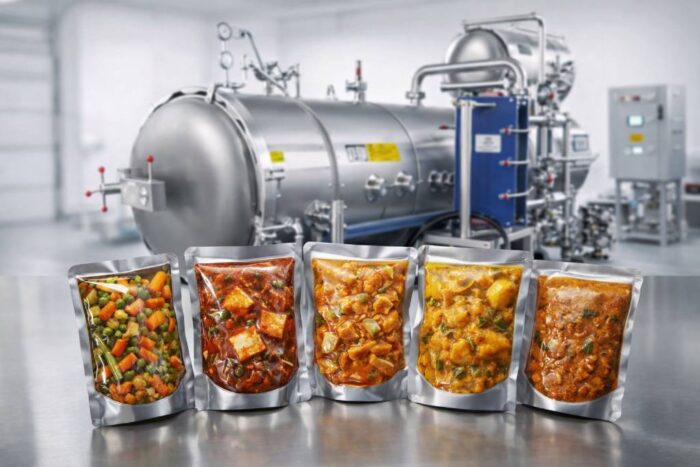
A Simple Guide for Food Manufacturers
Retort Food Processing Technology is the backbone of shelf-stable ready-to-eat foods like gravies, curries, soups, and stews. But one small number decides whether these foods are safe, legal, and export-ready — F₀.
At TamilCrew Global, we work with MSME food manufacturers across Tamil Nadu who want to scale into national and global markets. This guide explains retort science in simple words.
What is Retort Food Processing Technology?
Retort processing is a thermal sterilization method used to make food shelf-stable at room temperature.
Food is sealed inside a pouch, tray, or can and then heated in a pressurized vessel (retort) at temperatures above 121°C. This kills dangerous bacteria and spores that would otherwise spoil the food or make it unsafe.
Once processed, the food can be stored without refrigeration for months.
1. What is F₀ (in simple terms) in Retort Food Processing Technology?
F₀ = total equivalent minutes at 121.1°C delivered to the coldest point of your pouch/can.
It represents how much lethal heat your product received to kill Clostridium botulinum spores.
For low-acid foods like:
- Fish gravy
- Prawn curry
- Crab soup
Minimum commercial standard:
F₀ = 6.0 (minimum)
Industry safe range: F₀ = 8 to 12
Most exporters use F₀ = 9–10 for fish gravies.
2. What You Need to Measure F₀ in Retort Food Processing Technology
You cannot guess F₀. You must measure it.
You need:
- Retort with data logger / thermocouple
- Product core probe (inserted into the cold spot of pouch)
- Time–temperature recording system
- Software or manual F₀ calculation
3. Identify the Cold Spot (Very Important)
For fish gravy in retort pouch:
| Pack type | Cold spot location |
|---|---|
| Flat pouch | Geometric center |
| Stand-up pouch | Lower third, center |
| Semi-liquid gravy | Near fish piece mass |
Insert the thermocouple inside the thickest fish piece + gravy.
4. Run a Heat Penetration Trial
Process your pouch at:
121.1°C (250°F)
Example cycle: 30–45 minutes
Record:
- Retort temperature every 30 sec
- Core temperature inside pouch
You will get a curve like:
Time (min) | Core Temp (°C)
0          | 28
5          | 60
10         | 92
15         | 108
20         | 118
25         | 121
30         | 121
5. Calculate F₀ (Practical Method)
Lethality Formula (for Retort Processing)
Where:
- L = lethality (relative killing power)
- T = product core temperature (°C) at that time
- 121.1°C = reference temperature
- z = 10°C (for Clostridium botulinum)
Example
If the core temperature is 119.5°C:L=1010(119.5−121.1)=10−0.16≈0.69
So 1 minute at 119.5°C = 0.69 minutes of lethality at 121.1°C.
To calculate F₀
Use the formula:
Where:
- T = product core temperature at that minute
- z = 10°C for Clostridium botulinum
- Δt = time interval (min)
Example (simplified)
| Temp | Lethality |
|---|---|
| 111°C | 0.1 |
| 121°C | 1.0 |
| 131°C | 10 |
If your product stayed:
- 5 min at 118°C → 0.5 lethality each min → 2.5
- 10 min at 121°C → 1 × 10 = 10
- 5 min at 115°C → 0.3 × 5 = 1.5
Total F₀ = 14.0
6. Target for Fish Gravy
| Product | Safe F₀ |
|---|---|
| Fish curry/gravy | 8 – 10 |
| Prawn curry | 8 – 9 |
| Crab soup | 7 – 8 |
| Thick fish masala | 10 – 12 |
You should validate shelf life at F₀ = 8, 9, 10 and choose best sensory + safety balance.
7. Validation (Mandatory for Export)
You must:
- Do 3 heat penetration runs
- Prove minimum F₀ achieved at cold spot
- Keep records for FSSAI, FDA, APEDA
This becomes your Scheduled Process.
8. What is 12D and Why It Matters
Imagine your food has 1 billion tiny bad germs 🦠
You heat the food.
Every time you heat enough:
- 90% of the germs die
- 10% survive
That is called 1D.
Now you do this again and again:
| Step | Germs left |
|---|---|
| Start | 1,000,000,000 |
| 1D | 100,000,000 |
| 2D | 10,000,000 |
| 3D | 1,000,000 |
| 4D | 100,000 |
| 5D | 10,000 |
| 6D | 1,000 |
| 7D | 100 |
| 8D | 10 |
| 9D | 1 |
| 10D | 0.1 |
| 11D | 0.01 |
| 12D | 0.001 |
So after 12D, there is basically no chance of even one germ left.
Why 12D matters
Because Clostridium botulinum is extremely dangerous.
So food safety laws say:
“Kill it so completely that the chance of survival is almost zero.”
That safety rule is called 12D.
That’s why retort foods must meet a validated F₀.
10. Low-Acid vs Acidified Foods
| Type | pH | Example | F₀ needed |
|---|---|---|---|
| Low-acid food | > 4.6 | Fish curry, meat gravy, dal | Yes |
| Acidified food | ≤ 4.6 | Pickles, chutneys, tomato sauces | No |
Fish gravy is a low-acid food, so it must be retorted and validated using F₀.
11. Why Fish Gravy Needs F₀
Fish gravy contains:
- Protein
- Fat
- Oil
- Spices
- Water
This combination protects bacteria from heat.
So we must prove scientifically that even the coldest part of the fish chunk becomes safe.
12. Why Water Activity (aw) Matters in Retort Food Processing Technology
When we talk about food safety, most people think only about pH.
But there is another invisible factor that is just as important:
Water Activity (aw)
For shelf-stable foods like fish gravy, mushroom soup, and ready-to-eat curries, pH and aw together decide whether dangerous microbes can grow.
What is Water Activity (aw)?
Water activity measures how much “free water” is available in food for microbes to grow.
It is measured on a scale from:
- 0.00 → completely dry
- 1.00 → pure water
Most gravies, soups, and curries fall between:
aw = 0.97 to 0.99
This means they contain plenty of water for microbes.
Why aw is Critical for Safety for Retort Food Processing Technology
The most dangerous foodborne bacterium in low-acid foods is
Clostridium botulinum.
It can grow only when both of these conditions are true:
- pH > 4.6
- aw > 0.85
If your product meets both, it is classified as a Low-Acid Canned Food (LACF) and must be retort processed.
Examples
| Product | Typical pH | Typical aw | Retort needed? |
|---|---|---|---|
| Fish gravy | 6.0 | 0.98 | Yes |
| Mushroom soup | 6.2 | 0.99 | Yes |
| Vadakari | 6.0 | 0.96 | Yes |
| Dry chutney powder | 5.5 | 0.40 | No |
How Water Activity is Measured
Water activity is measured using a water activity meter.
Steps:
- Place a small sample in the sample cup
- Insert into the aw meter
- Wait for stabilization (1–3 minutes)
- Record the value
This test should be done for:
- Every new product
- Process validation
- Export documentation
pH tells you how acidic your food is, aw tells you how much water microbes can use — together they decide whether retort is mandatory.
13. Why Temperature Goes Up and Down
The curve rises during heating, stays flat during holding, and then falls during forced cooling.
Cooling is done intentionally to stop cooking and protect pouch seals.
14. Why Pressure Is Needed in Retort Food Processing Technology
At normal pressure, water boils at 100°C.
Retort uses pressure so water can reach 121°C without boiling.
Heat kills. Pressure protects.
Pressure allows high temperature while preventing pouch bursting.
15. Common Mistakes Manufacturers Make in Retort Food Processing Technology
- Guessing F₀ without validation
- Not testing the cold spot
- Using too high temperature (131°C) and damaging quality
- Ignoring headspace and pouch size effects
16. How Tamil Nadu MSMEs Can Export Safely
TamilCrew Global helps manufacturers:
- Classify products correctly
- Design safe retort cycles
- Validate F₀ with Process Authorities
- Prepare export compliance for India, USA, and Africa
Final Thought on Retort Food Processing Technology
F₀ is not just a number.
It is your product’s safety passport to the global market.
If you manufacture ready-to-eat foods and want to go global, TamilCrew Global is your process and export partner.
RTE Product Development Pipeline using Retort Food Processing Technology
- Prepare the gravy (final recipe)
- Exact ingredients
- Final salt, oil, spice levels
- Worst-case thickness & chunk size
- Cool to room temperature
- Homogenise
- Blend to uniform paste
- Blend to uniform paste
- Measure pH
- On homogenised sample
- On homogenised sample
- Measure water activity (aw)
- On homogenised sample
- On homogenised sample
- Classify the product
- If pH > 4.6 AND aw > 0.85 → Low Acid Food (LACF)
- If pH > 4.6 AND aw > 0.85 → Low Acid Food (LACF)
- Select target F₀
- Based on product type (fish, soup, thick curry, etc.)
- Confirmed by Process Authority
- Heat penetration study
- Place thermocouple in cold spot
- Run retort
- Record temperature vs time
- Calculate achieved F₀
- Adjust retort time
- Increase or reduce to reach target F₀
- Repeat & validate
- 3 consistent runs
- Issue Scheduled Process
- Approved for production & export
Further Reading & Guides
https://extension.purdue.edu/extmedia/FS/FS-154-W.pdf
You may also be interested in this manufacturer of Premium Plant-Based Vegan Leather.
Passaro