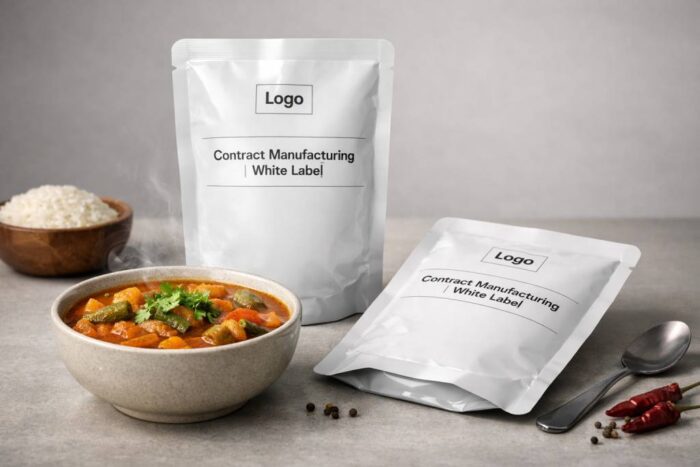
If you are exploring the technical world of retort-rte-food-manufacturing, you’ve likely realized that scaling a brand is about much more than just a great kitchen recipe. So, you’re looking to enter the Ready-to-Eat (RTE) market—maybe you have a stellar family recipe, or perhaps you’ve spotted a gap in the Indian diaspora market in the US, UK, or UAE.
The hurdle isn’t the flavor; it’s the physics of the shelf. Without cold-chain logistics, your options are preservatives (which consumers hate) or retort technology (which consumers love).
Why Retort is the “Holy Grail” for Food Startups
Retort processing is essentially high-pressure steam sterilization. It allows you to package traditional Indian food in a way that stays fresh for 6–12 months at room temperature.
- Taste Retention: Modern 4-ply pouches lock in the “tempering” (tadka) better than freezing ever could.
- Zero Preservatives: The heat kills the bacteria, not the chemicals.
- Ambient Logistics: Store it on a shelf, ship it in a regular truck, and save 30% on cold-storage costs.
1. Product Feasibility: Will Your Dish Work?
Not every dish is a candidate for retort. High-heat processing changes textures.
- The Winners: Dal Makhani, Rajma Masala, Paneer-based gravies, Biryanis, and Poha.
- The Challenges: Leafy greens (they turn brown), fried items (they lose crispiness), and delicate seafood (can become rubbery).
Pro Tip: Your home recipe will need “Standardization.” Scaling from a 2-liter pot to a 100-kg retort batch requires adjusting spices and moisture levels to account for the F0 (Sterilization Value).
2. The Compliance Roadmap for Retort RTE Food Manufacturing
To sell in India or export, you cannot skip these steps.
- FSSAI License: The basic requirement for food business in India.
- FSSC 22000/GMP & HACCP): Critical for international credibility and food safety.
- Export Readiness: Depending on the country, you’ll need APEDA registration, USFDA (for America), or specific EU certifications.
- Lab Testing: Accelerated shelf-life studies and nutritional labeling are non-negotiable.
All our processes are designed to meet the stringent safety standards set by the Food Safety and Standards Authority of India (FSSAI), ensuring that every pouch is shelf-stable and safe for consumption.
3. Costing & Investment: What Does It Actually Take for Retort RTE Food Manufacturing?
Many founders assume they need to build a factory on Day 1. You don’t.
| Expense Category | Self-Owned Facility | Private Label (Contract Mfg) |
| Machinery (Retort/Boiler) | High (₹50L – ₹1.5 Cr+) | Zero |
| Minimum Order (MOQ) | Flexible | Reasonable (e.g., 400+ units/batch) |
| Speed to Market | Slow (6-12 months) | Fast (1-2 months) |
| Operational Risk | High | Low |
By utilizing a contract manufacturing partner (Private Labeling), you can launch a brand for a fraction of the cost, focusing your capital on marketing and distribution instead of stainless steel.
4. How I Help Founders & MSMEs in Retort RTE Food Manufacturing
Navigating the technical side of food science is overwhelming. I bridge the gap between your kitchen and a market-ready product.
My services include:
- Recipe-to-Retort Conversion: Adjusting your taste profile for shelf stability.
- Costing Analysis: Deep-diving into the landed cost per pouch to ensure your margins are healthy.
- Manufacturing Access: I hold an MOU with a state-of-the-art retort facility, allowing you to bypass massive R&D overheads.
- Packaging Guidance: Selecting 3-ply or 4-ply pouches that survive the rigors of international shipping.
Our Manufacturing Capabilities – Retort RTE Food Manufacturing: From Regional Roots to Global Tables
We don’t just offer “generic” food. We specialize in the complex, authentic flavors of South India and beyond. Below is a sample of our production-ready portfolio that can be private-labeled or customized for your brand:
🍲 The South Indian Heritage Range
The most difficult flavors to replicate in retort are the “tangy and tempered” notes of South India. We have mastered:
- Signature Gravies: Thanjavur Sambar, Sundakkai Vatha Kuzhambu, and authentic Poondu (Garlic) Kuzhambu.
- Vegetable Classics: Traditional Aviyal, Mixed Veg Kurma, and Pudalangai Kootu.
- The Breakfast Club: Ghee Pongal and Chennai-style Vada Curry.
🍚 Health-Conscious & One-Pot Meals
Ideal for the office-goer or the fitness enthusiast:
- Grains: Bisi Bele Bath and Quinoa Khichdi.
- Regional Dals: Andhra Palak Pappu and Gongura Pappu.
🍛 Pan-Indian & Global Favorites
For brands looking for mass-market appeal:
- North Indian Staples: Dal Tadka, Punjabi Chole, and Kadai Paneer.
- Street Food: Pav Bhaji Masala and Momo/Garlic Chutneys.
🥘 Biryani Base Pastes (The “Chef’s Secret”)
High-margin products for the HoReCa segment or home cooks:
- Bengaluru Donne Biryani Paste
- Andhra Nellore Biryani Paste
Have a custom family recipe? We specialize in Recipe Standardization. If you have a specific regional taste or a unique “Secret Sauce,” we can adapt it for retort processing while maintaining its soul and flavor profile.
Frequently Asked Questions: Mastering Retort RTE Food Manufacturing
To help you navigate the transition from a kitchen concept to a commercial shelf-stable brand, here are the most common questions we receive regarding retort-rte-food-manufacturing.
1. Does retort processing require chemical preservatives?
No. This is the biggest advantage of retort-rte-food-manufacturing. The high-heat, high-pressure sterilization process kills all food-spoiling bacteria inside the sealed pouch. This allows the food to stay fresh for 6–12 months at room temperature while maintaining a “Clean Label.”
2. How does the taste of retort food compare to frozen food?
While frozen food preserves texture well, it is prone to freezer burn and requires a continuous cold chain. Retort technology locks in the “freshly cooked” aroma and the essential oils of spices (like in our Sambar and Biryani pastes), often providing a more authentic “tempered” (tadka) flavor profile once reheated.
3. Can you scale my specific family recipe for white labeling?
Yes. Our R&D process involves taking your “small-pot” recipe and standardizing it for 100kg+ batches. We perform $F_0$ value testing to ensure that the heat penetration is consistent, so your recipe tastes the same in a thousand pouches as it does in your kitchen.
4. What are the Minimum Order Quantities (MOQs) for contract manufacturing?
Because retort-rte-food-manufacturing is a batch-based process, MOQs typically depend on the batch size of the retort machinery. For most startups, we recommend starting with a trial run of 500–1,000 pouches to test the market before moving to high-volume production.
5. What kind of packaging is used in this process?
We use high-barrier, multi-layered pouches (typically 4-ply with aluminum foil or 3-ply transparent). These pouches are specifically engineered to withstand the $121^\circ\text{C}$ temperatures of the retort chamber without leaching or tearing.
6. Is the food safe for export even if we aren’t focusing on it yet?
Absolutely. Even if you are focusing on the domestic Indian market, our manufacturing standards follow HACCP and FSSAI guidelines, which are the foundation for international compliance. This makes your brand “export-ready” whenever you decide to scale.
Still have questions about the process?
Launching a food brand is a massive undertaking, and choosing the right partner for retort-rte-food-manufacturing is the most critical decision you’ll make.
Ready to take the next step?
The global Indian RTE market is projected to grow exponentially as convenience becomes the top priority for busy professionals and students abroad.
If you have a specific dish in mind or want to review your product’s feasibility, let’s talk.
PASSARO INTERNATIONAL
87, Babu Nagar III Main Road,
Medavakkam, Chennai 600100.
sales@passarotrading.com